
Fleet management has historically been one of the most data-poor functions in commercial operations. Decisions about vehicle deployment, maintenance timing, driver performance, and route efficiency were made based on experience, intuition, and incomplete information. The costs of that information gap — excess downtime, reactive maintenance, fuel inefficiency, compliance violations, and insurance claims — were largely invisible because they were distributed across operating budgets rather than attributed to a single, measurable source.
Telematics technology has changed that equation fundamentally. Modern fleet telematics platforms generate continuous, real-time data streams from every vehicle in operation — engine diagnostics, GPS position, fuel consumption, driver behavior, hours-of-service status, brake events, and dozens of other parameters. For business leaders managing commercial vehicle assets, this shift from intuition to data-driven management is not a marginal improvement. It is a structural change in how fleet operations create or destroy value.
From GPS Tracking to Full Fleet Intelligence
The first generation of fleet telematics, deployed widely in the 2000s and early 2010s, was primarily GPS tracking — knowing where a vehicle was at any given moment. That capability had value for dispatch coordination and customer service, but its impact on operating costs was limited.
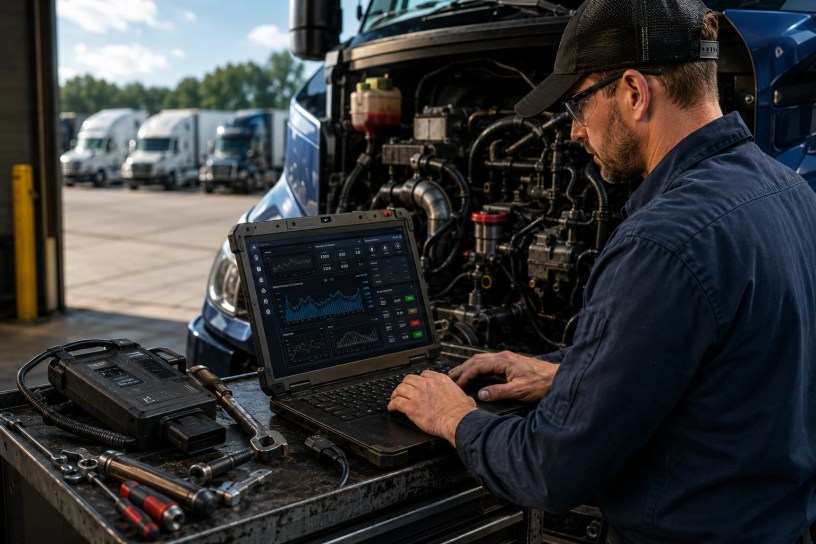
Contemporary telematics platforms are categorically different. They connect directly to a vehicle’s CAN bus — the electronic communication network that links every control module on the truck — and extract data from engine management systems, transmission controllers, aftertreatment monitors, brake controllers, and tire pressure systems simultaneously. The result is not just location data but a continuous health assessment of every critical vehicle system, updated in real time and accessible from a centralized dashboard.
The business intelligence generated by these platforms extends well beyond what any previous fleet management approach could produce. Fleet managers can now see, at a glance, which vehicles are running efficiently and which are degrading, which drivers are operating safely and which represent elevated accident risk, which routes are burning excess fuel and which are optimized — and they can act on that information before the financial damage occurs rather than after.
The Financial Case for Telematics Investment
The business case for fleet telematics investment has become increasingly straightforward as implementation data has accumulated across diverse fleet types and operating environments. The financial returns span multiple cost categories simultaneously, which is what makes telematics one of the highest-ROI technology investments available to companies operating vehicle assets.
Fuel efficiency improvements typically represent the largest and most immediate return. Route optimization algorithms reduce total miles driven by 10 to 20 percent compared to manually planned routes. Idle time monitoring and coaching reduce fuel consumption from unproductive engine running — a particularly significant cost for diesel fleets where idle time accumulates quickly. Combined, these improvements commonly deliver 8 to 15 percent reductions in fleet fuel spend — which, for a 50-truck operation burning 150,000 gallons per year, translates to $75,000 to $140,000 in annual savings at current diesel prices.
Maintenance cost reductions follow from predictive analytics capabilities. Research from the National Renewable Energy Laboratory’s Fleet DNA Program shows that telematics-enabled predictive maintenance reduces unscheduled downtime by 35 to 45 percent while extending component lifespan by 20 to 25 percent. Emergency roadside repairs — which cost three to five times more than scheduled shop work — drop by 40 percent for fleets with active predictive maintenance programs.
Insurance cost reduction is a third financial lever. Commercial fleet insurers increasingly offer usage-based programs that price premiums based on actual telematics safety data rather than historical loss experience alone. Fleets with documented improvements in hard braking frequency, speeding incidents, and hours-of-service compliance regularly achieve 15 to 25 percent premium reductions compared to undifferentiated market rates.
Predictive Maintenance: The Highest-ROI Application
Among all telematics applications, predictive maintenance consistently delivers the strongest return on investment — and the most dramatic operational improvement for fleet managers who implement it correctly.
The core mechanism is straightforward: telematics systems monitor engine parameters, sensor outputs, and component performance continuously. When values deviate from established baselines — oil pressure trending downward, coolant temperature rising above normal range, DPF soot load approaching service threshold — the system generates an alert days or weeks before the deviation becomes a failure. Maintenance can be scheduled during planned downtime rather than responding to a roadside breakdown.
The financial impact compounds across multiple cost categories. A breakdown prevented is a towing bill avoided, a rental vehicle not needed, a driver not sitting idle on the shoulder of a highway, a delivery not missed, and a customer relationship not damaged. The aggregate cost of a single unplanned breakdown for a Class 8 commercial truck commonly runs $3,000 to $8,000 when every variable is accounted for. A predictive maintenance alert that prevents one breakdown per truck per quarter covers the annual cost of most telematics subscriptions — before any fuel savings, insurance reductions, or compliance benefits are counted.
For fleet managers and business leaders evaluating how predictive maintenance for trucking translates to measurable operational outcomes, the technology has matured well beyond proof-of-concept. Well-implemented systems now predict component failures 10 to 20 days in advance with 85 to 90 percent accuracy — a level of reliability that justifies full operational integration rather than cautious pilot programs.
Compliance Automation and Regulatory Risk Reduction
Commercial vehicle operations in North America are among the most heavily regulated business environments in any industry. Hours-of-service requirements, vehicle inspection mandates, weight restrictions, emissions compliance, drug and alcohol testing programs, and driver qualification standards all generate ongoing compliance obligations that carry significant financial penalties for non-compliance.
Electronic Logging Devices — mandatory for most interstate commercial carriers since December 2019 — are the most visible compliance application of telematics. ELDs automatically record driver hours, eliminate manual logbook falsification, and generate FMCSA-compliant records without driver intervention. Beyond regulatory compliance, ELD data gives fleet managers accurate operational data on driving time, on-duty time, and rest patterns that improves scheduling efficiency and reduces the administrative burden of hours-of-service management.
Driver Vehicle Inspection Reports (DVIR) — the pre-trip and post-trip inspection records required under FMCSA regulations — are increasingly completed digitally through telematics-integrated mobile applications. Defects identified during inspection are immediately routed to maintenance teams, creating a documented repair chain that satisfies regulatory requirements and protects the company in the event of a post-accident investigation.
Driver Performance Management at Scale
Managing driver behavior across a commercial fleet has traditionally required direct supervision that scales poorly beyond a handful of vehicles. A dispatcher managing 50 drivers cannot observe driving behavior directly — they can only respond to complaints, accidents, and violations after the fact.
Telematics changes the supervisory model entirely. Driver scorecards generated automatically from telematics data quantify hard braking events, speeding incidents, rapid acceleration, cornering forces, seatbelt compliance, and mobile device usage while driving — for every driver, on every shift, without human observer time. Managers can identify high-risk drivers before an accident occurs, deliver coaching based on objective data rather than subjective observation, and track improvement over time with measurable benchmarks.
The downstream effects on insurance costs, accident frequency, and vehicle wear are well-documented. Fleets that implement telematics-based driver coaching programs report 25 to 40 percent reductions in accident rates within the first year — improvements that compound over time as safe driving habits become embedded in organizational culture.
Choosing the Right Platform for Your Operation
The fleet telematics market has matured significantly, with a range of platforms now serving fleets from five vehicles to five thousand. The evaluation criteria that matter most depend on fleet size, vehicle type, regulatory environment, and the specific operational problems you are trying to solve.
For enterprise fleets operating Class 6 through Class 8 commercial trucks, the evaluation should prioritize J1939 protocol compatibility (ensuring the platform can read heavy-duty truck data natively), predictive maintenance depth, ELD compliance certification, and integration capability with existing dispatch, maintenance management, and accounting systems. A comprehensive analysis of leading fleet telematics software platforms — covering Verizon Connect, Samsara, Geotab, and others across 51 evaluation criteria — provides a structured framework for that assessment.
The Strategic Imperative
Fleet telematics has crossed the threshold from competitive differentiator to operational necessity for commercial vehicle operators. Major shippers and logistics customers increasingly require real-time tracking visibility as a vendor qualification criterion. Insurance underwriters expect telematics data as part of the underwriting process. Regulatory agencies are expanding electronic reporting requirements. And the operating cost environment — rising fuel prices, increasing maintenance complexity, escalating insurance rates — has made data-driven efficiency management a financial necessity rather than an optional investment.
For business leaders with fleet assets on their balance sheet, the question is no longer whether to invest in telematics. It is which platform best fits the operation, how to build the internal capability to use the data effectively, and how to measure the return on investment accurately enough to justify ongoing technology spend to financial stakeholders. The organizations that answer those questions well will manage their fleet assets significantly more profitably than those that don’t.
About the Author:- Michael Nielsen is the editor and publisher of Heavy Duty Journal, a free digital trade publication serving diesel technicians, fleet managers, and owner-operators in the commercial trucking industry. He brings 15+ years of hands-on experience in diesel repair and fleet operations to HDJ’s editorial coverage.

